
 By admin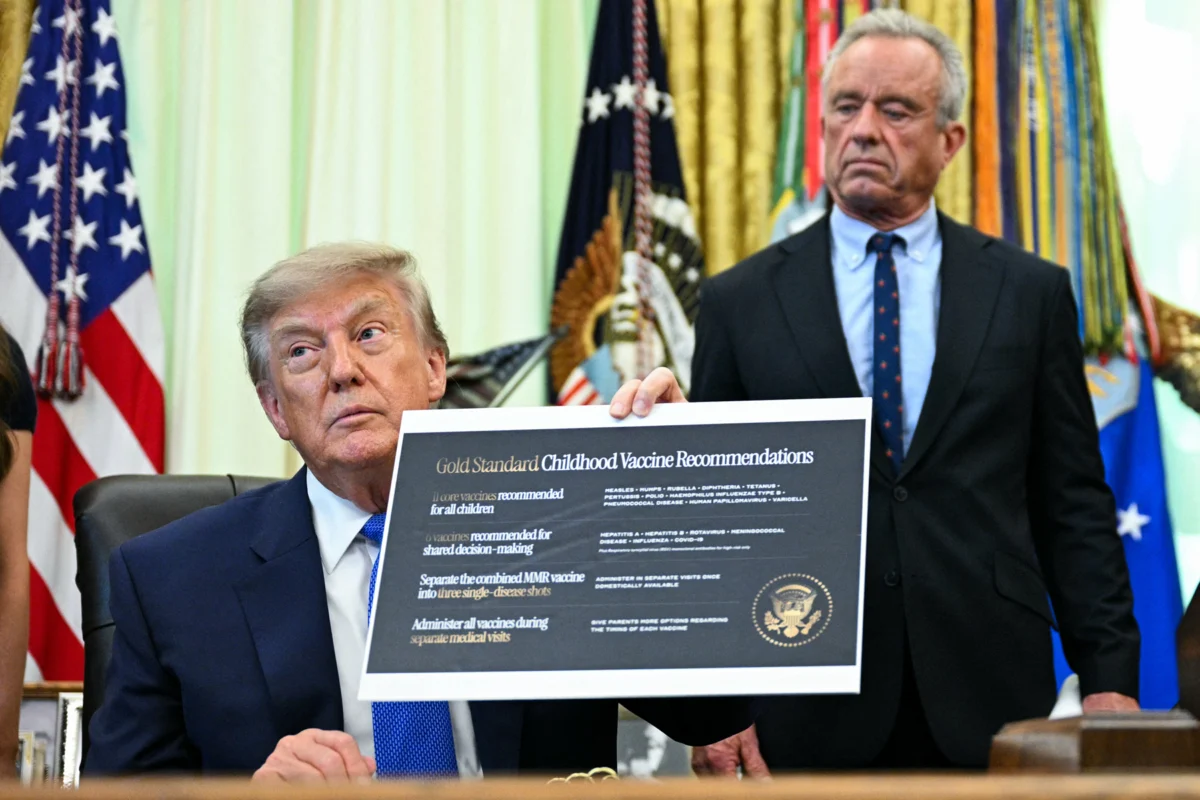
HangupsMusic.com – Washington D.C., The nation’s public health landscape faces an unprecedented restructuring following President Donald Trump’s signing of an executive order that dramatically alters the recommended childhood immunization schedule. The decree, unveiled on Monday, August 10, 2026, marks a significant departure from established medical consensus, fueled by the scientifically discredited notion linking vaccines to autism spectrum disorder. This move comes just weeks after reports surfaced of the President’s dissatisfaction with Health Secretary Robert F. Kennedy Jr.’s progress in embedding these theories into federal health policy.
Speaking from the Oval Office, President Trump presented the executive order as establishing "the United States of America’s gold standard childhood vaccination recommendations." He explicitly connected the policy shift to concerns regarding autism, stating, "That has to do with many subjects including autism in particular." This public declaration underscores a persistent, yet scientifically unfounded, belief that has long been a focal point for a vocal minority. For decades, exhaustive research by medical experts, leading scientific bodies, and public health organizations worldwide has unequivocally concluded that no causal link exists between childhood vaccinations and autism. Studies involving hundreds of thousands of children across multiple continents have consistently debunked this theory, yet it continues to exert influence in certain political and social circles.
Sources close to the administration had previously indicated the President’s growing frustration with Secretary Kennedy. Last month, reports detailed Trump’s complaints to Kennedy and others about the perceived lack of aggressive action to validate a connection between childhood vaccinations and autism. While Kennedy has a well-documented history of promoting vaccine skepticism, the President’s direct intervention suggests either a perceived inertia from his Health Secretary or a determination to personally drive this policy change.
During his announcement, President Trump invoked a romanticized past, asserting, "Decades ago children received only a small fraction of the vaccines. People were much healthier and, of course, the high rates of autism now observed did not exist. So there’s a reason for such epidemic rates of autism." This assertion, however, disregards decades of medical advancement and epidemiological data. The perceived increase in autism diagnoses is largely attributed to broader diagnostic criteria, greater public awareness, and improved screening methods, not an actual rise in incidence linked to vaccination. Childhood mortality and morbidity rates due to infectious diseases were significantly higher in the era Trump referenced, a stark reality often overlooked by proponents of reduced immunization.
The executive order, titled "Delivering Gold Standard Childhood Vaccine Recommendations for Americans," mandates substantial changes to the Advisory Committee on Immunization Practices (ACIP) recommendations, which traditionally guide healthcare providers. Critically, the order directs the elimination of several vaccines from general childhood recommendations. Immunizations against respiratory syncytial virus (RSV), hepatitis, and meningococcus will now only be advised for "certain high-risk groups or populations." Furthermore, routine vaccinations against influenza and Covid-19 are no longer universally recommended, instead falling under a category requiring "shared clinical decision-making" between parents and healthcare providers – a shift that could significantly reduce uptake for these widely beneficial inoculations.
Perhaps the most far-reaching change concerns the measles, mumps, and rubella (MMR) vaccine. Currently administered as a single, highly effective, and safe combined shot, the order demands a complete overhaul of its delivery. It stipulates that the MMR vaccine "be administered in three separate single-disease shots once such products are domestically available and that, to the maximum extent feasible, all childhood immunizations should be administered at separate medical visits." This directive raises immediate questions about the feasibility of manufacturing individual components, potential delays in vaccine availability, and the substantial logistical burden it places on families and healthcare systems.
In a moment characteristic of his communication style, President Trump illustrated his concerns with a vivid, if medically inaccurate, anecdote. He claimed that children’s vaccines often "look like the size of a bottle of soda" when administered, implying an overwhelming volume of substances being injected into a child’s body. This statement, shared widely across social media, overlooks the minute quantities of antigens and other components contained within standard vaccine doses, which are meticulously tested for safety and efficacy.
The implications of such a policy extend far beyond the political rhetoric. Mandating separate visits for each individual vaccine shot translates into significant practical and economic burdens for American families. Parents would face increased time off work, greater childcare expenses, and a surge in co-pays and medical bills. This logistical nightmare could deter parents from completing their children’s immunization schedules, leading to incomplete protection against preventable diseases. Public health experts warn that a widespread reduction in vaccination rates could severely compromise herd immunity, making communities vulnerable to outbreaks of diseases that were once largely eradicated or controlled, such as measles, mumps, and rubella. The potential resurgence of these highly contagious illnesses could strain healthcare resources, lead to preventable fatalities, and disrupt societal functions, including school attendance.
The executive order has not been met with universal approval, even within the President’s own party. Shortly after the announcement, Senator Bill Cassidy of Louisiana, a licensed medical doctor, publicly rebuked the President’s actions. Via social media, Cassidy declared the executive order "so wrong," emphasizing that "The President does not have the expertise to make these changes." He reiterated the established scientific consensus: "Vaccines are overwhelmingly safe. Vaccines are effective. Vaccines DO NOT cause autism." This rare public dissent from a medical professional within Republican ranks highlights the profound chasm between scientific evidence and the administration’s new health policy. It is noteworthy, however, that Senator Cassidy had voted to confirm Robert F. Kennedy Jr. as HHS Secretary the previous year, despite Kennedy’s well-known history of promoting vaccine conspiracy theories. Unsurprisingly, Secretary Kennedy, who was present during the order’s signing, subsequently lauded President Trump for championing "gold-standard science" – a phrase that stands in stark contrast to the overwhelming scientific community’s assessment.
The President’s adoption of the scientifically disproven link between autism and vaccines appears to be a more recent priority, largely influenced by the "Make America Health Again" (MAHA) movement spearheaded by Robert F. Kennedy Jr. This movement, often characterized by its skepticism of conventional medicine and public health guidelines, has found a powerful platform within the highest echelons of government. The historical pattern, often observed when fringe ideologies gain traction in policymaking, is that society as a whole bears the consequences. The sweeping changes introduced by this executive order represent a profound gamble with the health and well-being of the nation’s children, posing a challenge not only to established medical science but also to the very fabric of public health infrastructure. The long-term societal and health impacts of this radical shift remain to be seen, but the initial reactions from the medical and scientific communities are unequivocal in their alarm.
