
 By admin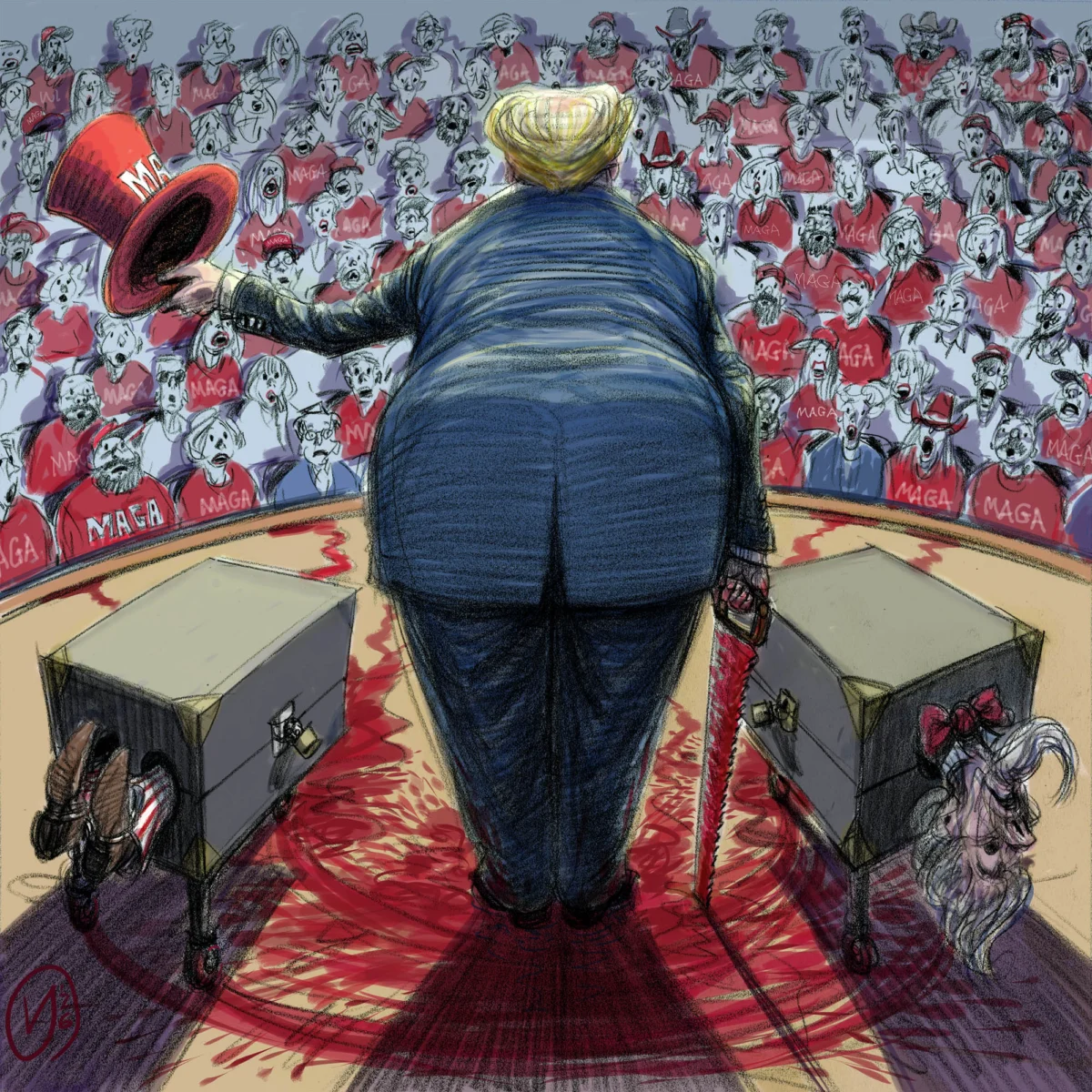
HangupsMusic.com – The political landscape, much like the ever-evolving music scene, is often defined by singular, resonant moments that capture the essence of an era. In the early autumn of 2005, following the devastating impact of Hurricane Katrina on New Orleans, former President George W. Bush delivered an ad-libbed remark that would echo through his entire second term: "Brownie, you’re doing a heck of a job." Intended as a simple commendation for FEMA Director Michael Brown, the phrase quickly became a sardonic anthem, symbolizing an administration perceived as detached and fundamentally out of sync with the gravity of unfolding crises. It encapsulated a public narrative of insufficient federal response, painting a picture of leadership either unable or unwilling to grasp the scale of the challenges, becoming a recurring refrain for every subsequent governmental misstep.
Fast forward to a more recent political era, and while President Donald Trump’s casual "great job" offered to Marco Rubio during a State of the Union address didn’t quite achieve the same indelible cultural footprint, the underlying narrative appears strikingly similar. Despite Trump’s characteristic flair for distraction, often manifesting in provocative online posts and a penchant for spectacle, a discernible pattern suggests his second term is charting a course toward even deeper political waters than his predecessor. The burdens weighing on his administration, paradoxically, mirror those that defined Bush’s later years, hinting at a cyclical struggle with the demands of governance.
Intriguingly, the current challenges facing the Trump administration don’t seem to stem primarily from its ideological framework. While critics readily point to its assertive, nationalist, and occasionally isolationist policy stances – positions that might, in another context, alienate a broad swath of moderate American voters – a historical perspective reveals a surprising degree of public acceptance. Many independent and centrist voters, for instance, have shown a consistent, albeit nuanced, alignment with the administration’s immigration rhetoric since its initial emergence. Even a segment of populist-leaning voters has found common ground with an "America First" foreign policy and calls for domestic manufacturing protectionism. Furthermore, while the specter of presidential self-enrichment might conventionally be a political Achilles’ heel, public reaction to such allegations has often been less decisive than anticipated, suggesting that these ideological or ethical concerns are not, in themselves, the primary drivers of current political headwinds.
Instead, the prevailing sentiment points to a more fundamental issue: a perceived systemic breakdown in operational capability. The public narrative has shifted from debate over policy direction to profound questions about executive execution. The vivid imagery of federal agents operating with unchecked authority in domestic settings, for example, represents a stark departure from established norms and has elicited widespread concern. Similarly, embarking on significant foreign policy initiatives, such as military engagement in Iran, without a clearly articulated rationale or a thoroughly considered roadmap for potential repercussions, has historically proven to be a swift route to public disapproval. Data from organizations like Pew Research indicates a significant majority of Americans express dissatisfaction with the administration’s handling of such conflicts, a sentiment unlikely to abate without clear evidence of strategic competence. Compounding this, tangible disruptions in everyday life – from a surge in fuel costs and escalating mortgage rates to the erratic fluctuations of financial markets and the palpable disarray in major transportation hubs – contribute to a growing perception of an administration struggling to maintain foundational order.
The concept of basic governmental functionality, a bedrock expectation for any administration, seems to have undergone a significant transformation between Trump’s first and second terms. His initial tenure saw a rotation of senior aides – many from traditional party backgrounds or with military experience – who often implicitly functioned as institutional buffers, mediating between the president’s unconventional impulses and the complex machinery of federal agencies. However, a period away from office appears to have liberated the president from these moderating influences. His second-term cabinet and inner circle are predominantly populated by figures from the fringes of political discourse, often commentators or ideologues more adept at public debate than at the intricate, often tedious, work of managing vast bureaucracies. This cadre, frequently characterized by its disdain for conventional governmental structures, embarked on what many observers deemed an audacious, yet fundamentally precarious, experiment in governance.
The daily chronicles of administrative missteps have become almost too numerous to detail exhaustively. Examples, whether factual or hyperbolically recounted by critics, paint a picture of an organization adrift: a Secretary of Homeland Security allegedly allocating substantial funds to self-promotional media campaigns, featuring horseback rides at national monuments; an FBI director purportedly prioritizing personal leisure over pressing investigative duties, while simultaneously deploying security resources for non-official travel; a Secretary of Defense reportedly sanctioning the low-altitude flights of military helicopters over residential areas, seemingly without clear operational justification; and an Attorney General appointing legal officers whose professional backgrounds appeared better suited to local legal practice than the complexities of federal jurisprudence. Such anecdotes, regardless of their precise veracity, collectively contribute to a pervasive public impression of widespread operational negligence and a fundamental unseriousness regarding the duties of public office.
The symbolic weight of certain personnel changes further underscores this narrative of shifting standards. When the administration replaced a prominent figure like Kristi Noem with Markwayne Mullin – a former plumber and mixed martial arts fighter, whose public persona is often peppered with vague allusions to undisclosed military operations – the reaction from many seasoned Washington observers was one of resigned applause. This muted acceptance, as if a return to even a modest level of conventional experience were a triumphant achievement, speaks volumes about the perceived decline in the caliber of governmental appointments and the prevailing low expectations for administrative proficiency.
A long-held theory suggests that the electorate, while capable of tolerating a wide spectrum of presidential behaviors and policies, draws a firm line at what is perceived as a descent into systemic chaos. While former President Jimmy Carter’s "malaise" era famously included a bizarre incident with a swimming rabbit, the principle remains: the public craves the illusion of a president firmly at the helm, if only to ensure a sense of stability. Donald Trump, particularly in his first term, frequently challenged this axiom, often thriving amidst perceived disruption, which, paradoxically, became his most predictable trait. Yet, the current climate suggests this strategy is no longer resonating with the same efficacy.
The intersection of Trump’s economic policies and his perceived preoccupation with unsubstantiated claims of election fraud – a narrative largely confined to his most devoted online echo chambers – has reportedly alienated a significant cohort of independent voters who once supported him. Concurrently, a foreign policy approach perceived as impulsive and confrontational has reportedly created widening fissures within his core political base. Political prognostication currently suggests a challenging electoral environment for the Republican Party, with widespread expectations of losing control of the House of Representatives in upcoming elections. Furthermore, many analysts now believe the Democratic Party has a credible pathway to reclaiming the Senate, eyeing competitive races in historically Republican strongholds. What once was a potent political movement, MAGA, appears to be grappling with the perception of presiding over a governmental apparatus struggling to fulfill its most basic functions.
As individuals approach the later stages of life, it is often observed that their core characteristics become more pronounced. Similarly, there is a prevailing sense that Trump’s remaining time in office will be defined by an intensified focus on personal legacy projects – constructing grand ballrooms, arts centers, and elaborate monuments emblazoned with his name, tirelessly railing against architects, all in a fervent pursuit of a gold-leafed historical imprint. The trajectory of the broader "MAGA" movement, however, presents a more intricate question: What becomes of a political phenomenon once its charismatic figurehead faces rejection from the electorate?
Already, the nascent outlines of successor factions are taking shape. One emerging group might be termed the "True MAGA" wing – staunch adherents who contend that Trump himself deviated from the original "America First" doctrine, perhaps corrupted by entrenched insiders or diminished by a loss of mental acuity. Their proposed path forward is not to abandon the movement, but to purify it, returning to its foundational nativist and anti-globalist tenets, potentially even recalibrating its focus on identity politics. Figures like Marjorie Taylor Greene have strategically positioned themselves as inheritors of this authentic Trumpist mantle, as has media personality Tucker Carlson, whose influence should not be underestimated. Even J.D. Vance has subtly staked a claim within this faction, deftly balancing an expressed opposition to the Iran conflict with consistent demonstrations of unwavering loyalty.
Another discernible faction is what one might label the "Trump But" crowd, characterized by the implicit promise: "I am like Trump, but perhaps more refined or effective." After a notable, albeit late, conversion to the MAGA ethos, Senator Marco Rubio appears to be cultivating an image as a more polished, experienced, and broadly appealing iteration of the former president. Other senators, such as Josh Hawley and Ted Cruz, might position themselves as more intellectual Trumpian successors, ideologically aligned yet emphasizing economic fairness and a more cerebral approach to policy. Even Robert Kennedy Jr. might, with a certain strategic calculus, perceive an opportunity to merge remnants of the MAGA base with his own anti-corporate following, a move that, while perhaps unconventional, is not entirely devoid of political logic.
The unfolding interplay among these factions promises to be a fascinating political drama, potentially yielding substantive shifts in conservative ideology. However, any Republican aspiring to revitalize the remnants of the MAGA movement must also grapple with the fundamental question of governance. While competence alone has rarely served as a compelling centerpiece for presidential campaigns – as the historical narratives of figures like Michael Dukakis or Mitt Romney might suggest – its utter absence, a stupefying inability to execute, proves to be an insurmountable electoral liability.
The decline of George W. Bush’s presidency into a period of perceived chaos was not merely a temporary dip for the political right. It marked the definitive conclusion of a four-decade dominance for neoconservatism and ultimately paved the way for Trump’s ascendant, if tumultuous, takeover of the Republican Party. Similarly, the long-term viability of MAGA as a political force beyond Trump’s immediate influence will hinge not solely on its capacity to appeal to a particular demographic, but critically, on whether the Republican Party can shed the pervasive image of an entity that, while outwardly contemptuous of government, is fundamentally unserious about the rigorous demands of actually running it. The final act of this political overture remains unwritten, but the audience is keenly listening for a return to a more harmonious, or at least competent, score.
